
- Advanced state estimation: Gain real-time information about network conditions, including power flows, voltages and phase angles, power losses, and more.
- Volt/VAR Control (VVC): Minimize active and reactive power losses while keeping voltages within desired limits.
- Optimal power flow: Incorporate active grid elements such as HVDC, FACTS, and On-Load Tap Changers and more to reduce losses and enable sustainability.
- Generation and demand forecasting: Leverage advanced machine learning to improve the accuracy and granularity of forecasts, which are critical for balancing supply and demand during economic optimization.
- Open systems integration: Network Manager EMS easily integrates with other software, including systems used by external energy markets.
- Dynamic Line Ratings (DLR): Use imported, forecasted DLR values in real-time and look-ahead studies to help integrate renewables and operate the system and equipment closer to their limits.
- Stability analysis: Confirm whether your system is operating in a stable state by performing stability analysis calculations to assess the dynamic behavior of the system.
- Security analysis: Network Manager EMS performs a series of power flow calculations to check various contingency scenarios and detect possible current or voltage violations.
- Power flow analysis: Use the power flow engine combined with historical and future data, schedules, and forecasts to understand the state of your network and analyze different scenarios.
Network Manager Energy Management System (EMS)
Gain visibility and control of transmission grid operations with Network Manager EMS, built on a high-performance, cybersecure SCADA platform for mission-critical control systems. Advanced applications help you achieve system stability and reliability. From real-time control to predictive optimization, Network Manager enables safe, efficient operations.
Key highlights
- Enable safe and reliable power delivery
- Reduce power losses
- Integrate more renewables
Overview
The challenge
Transmission networks are getting more complex. The shift towards more renewable energy poses new technological challenges – delivering power over greater distances from remote generation sites to major demand centers and managing supply-side variability. Transmission infrastructure investments have not kept pace with growth and, as a result, many transmission systems today are operating at or very close to capacity. How do you tackle these challenges while delivering consistently superior service to your customers? Network Manager can help.
Integrate seamlessly
EMS is the optimal control center solution to enable secure, efficient, and optimized operation of the electric power system. EMS has an open platform that allows for easy integration with other utility information systems while maintaining high levels of security. It is the market-leading platform for building control center solutions to manage today’s as well as tomorrow’s grids. Its modular architecture can be tailored to the needs of each company to provide a smooth migration path for future expansion.
The applications are built on an open platform, and can be tuned for real-time control and analysis as well as predictive optimization and planning purposes. These powerful network operation tools facilitate safe and efficient day-to-day operation while minimizing long-term capital expenditures.
Scale with ease
Each EMS function is implemented as a separate software package and interfaced with the system through a real-time database. This makes it easy to tailor the system to user requirements, to define execution sequences and cycles individually, and to add new software modules from Hitachi Energy or third-party suppliers as your system evolves.
Deploy with speed
We help you move from upgrades to updates with faster deployments. This can be tailored to a single-component level with cluster technology.
Up to date with international standards
As information exchange and coordination between transmission system operators (TSOs) and other market participants become more important, Network Manager is continuously updated to support international and local standards for power system operation and data-exchange. This is done by working closely together with customers worldwide and actively participating in the development of international standards.
Enable safe and reliable power delivery
Evaluate system conditions using real-time and look-ahead applications such as state estimation and congestion forecasts.
Reduce power losses
Operate your transmission system more efficiently by optimizing voltage and regulating AC and HVDC power flows.
Integrate more renewables
Eliminate grid bottlenecks with advanced network application tools to facilitate renewables integration.
Benefits
Advanced state estimation: Gain real-time information about network conditions, including power flows, voltages and phase angles, power losses, and more.
Volt/VAR Control (VVC): Minimize active and reactive power losses while keeping voltages within desired limits.
Optimal power flow: Incorporate active grid elements such as HVDC, FACTS, and On-Load Tap Changers and more to reduce losses and enable sustainability.
Generation and demand forecasting: Leverage advanced machine learning to improve the accuracy and granularity of forecasts, which are critical for balancing supply and demand during economic optimization.
Open systems integration: Network Manager EMS easily integrates with other software, including systems used by external energy markets.
Dynamic Line Ratings (DLR): Use imported, forecasted DLR values in real-time and look-ahead studies to help integrate renewables and operate the system and equipment closer to their limits.
Stability analysis: Confirm whether your system is operating in a stable state by performing stability analysis calculations to assess the dynamic behavior of the system.
Security analysis: Network Manager EMS performs a series of power flow calculations to check various contingency scenarios and detect possible current or voltage violations.
Power flow analysis: Use the power flow engine combined with historical and future data, schedules, and forecasts to understand the state of your network and analyze different scenarios.
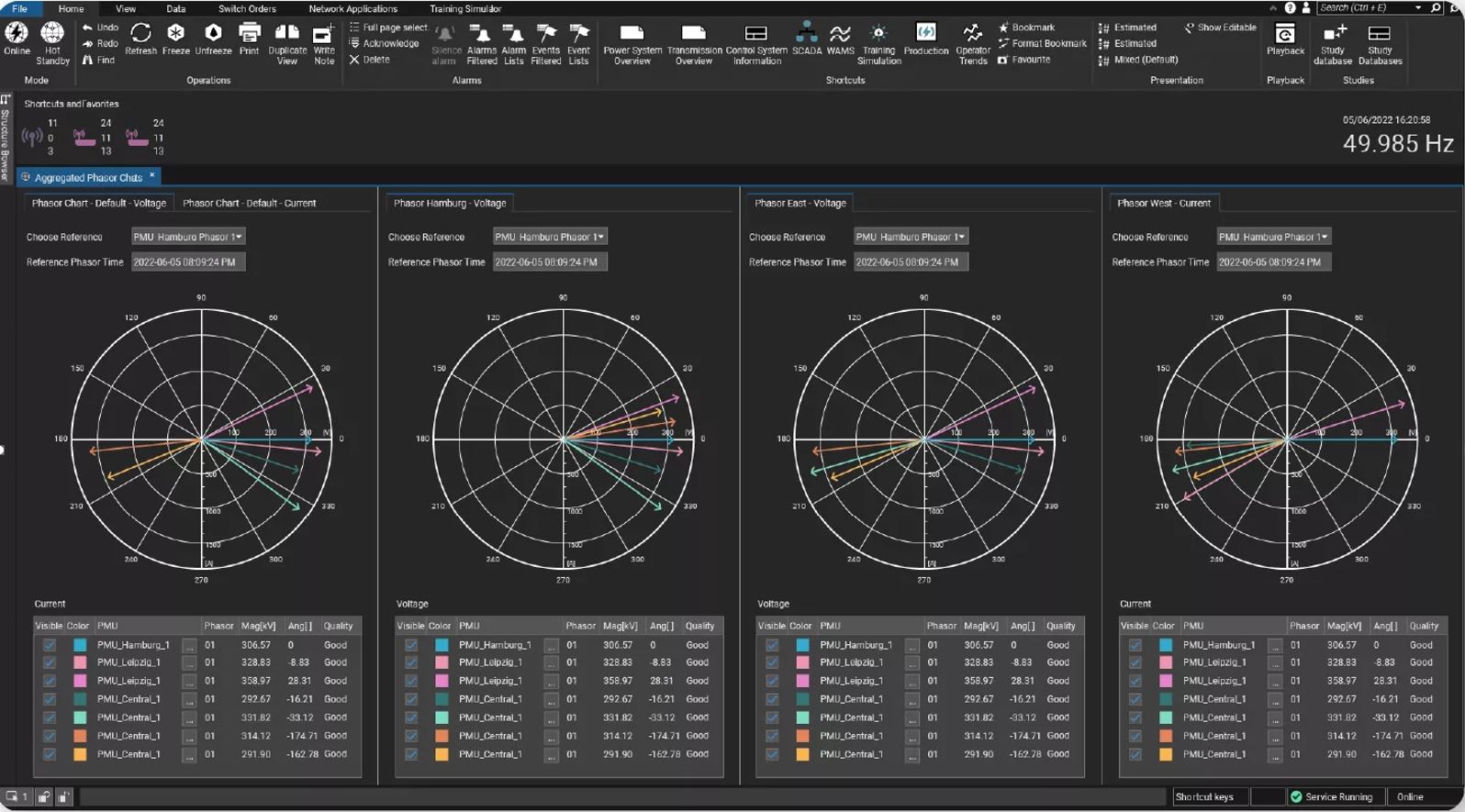
Wide Area Management System (WAMS): Monitor fast-developing power changes in real time by unlocking information from phasor measurement units (PMUs). Get more accurate analysis and insights into real time grid conditions by integrating WAMS with EMS/SCADA and operating with single data engineering and user interface.
Features
Full suite of network applications providing:
Superior information about network state
Early identification of transmission bottlenecks
Computation of transfer capacity
Identification and correction of security violations
Optimization of voltage levels across the transmission network
Support for congestion forecast workflows, including (multi-) day-ahead and intraday load-flow and security analysis (in support of ENTSO-E CACM and OS network codes)
Compliant with version 16 of CIM (IEC-61970) and ENTSO-E CGMES 2.4.15
Complete set of SCADA applications that:
Fulfill the supervisory control demands of the largest power systems
Efficiently support all operational states and handle disturbances
Graphical user interface to:
Improve situational awareness
Enable intuitive usage
Advanced design with:
Comprehensive operator training environment
Excellent execution performance
High-availability architecture with online data synchronization across multiple servers
Virtualization support
Graphical user interface to:
Improve situational awareness
Enable intuitive usage
Network Manager Supervisory Control and Data Acquisition (SCADA)
Network Manager SCADA is a real-time, cybersecure platform for a wide range of control and monitoring applications. Designed for mission-critical applications that demand high performance and availability – such as power generation, transmission and distribution systems, and electrical networks for transportation – it supports networks of all sizes.
Key highlights
- Reduced maintenance costs with data engineering tool
- Modern HMI enhances situational awareness
- Open architecture for improved IT/OT system interoperability
- Supports millions of devices and high data throughput
Overview
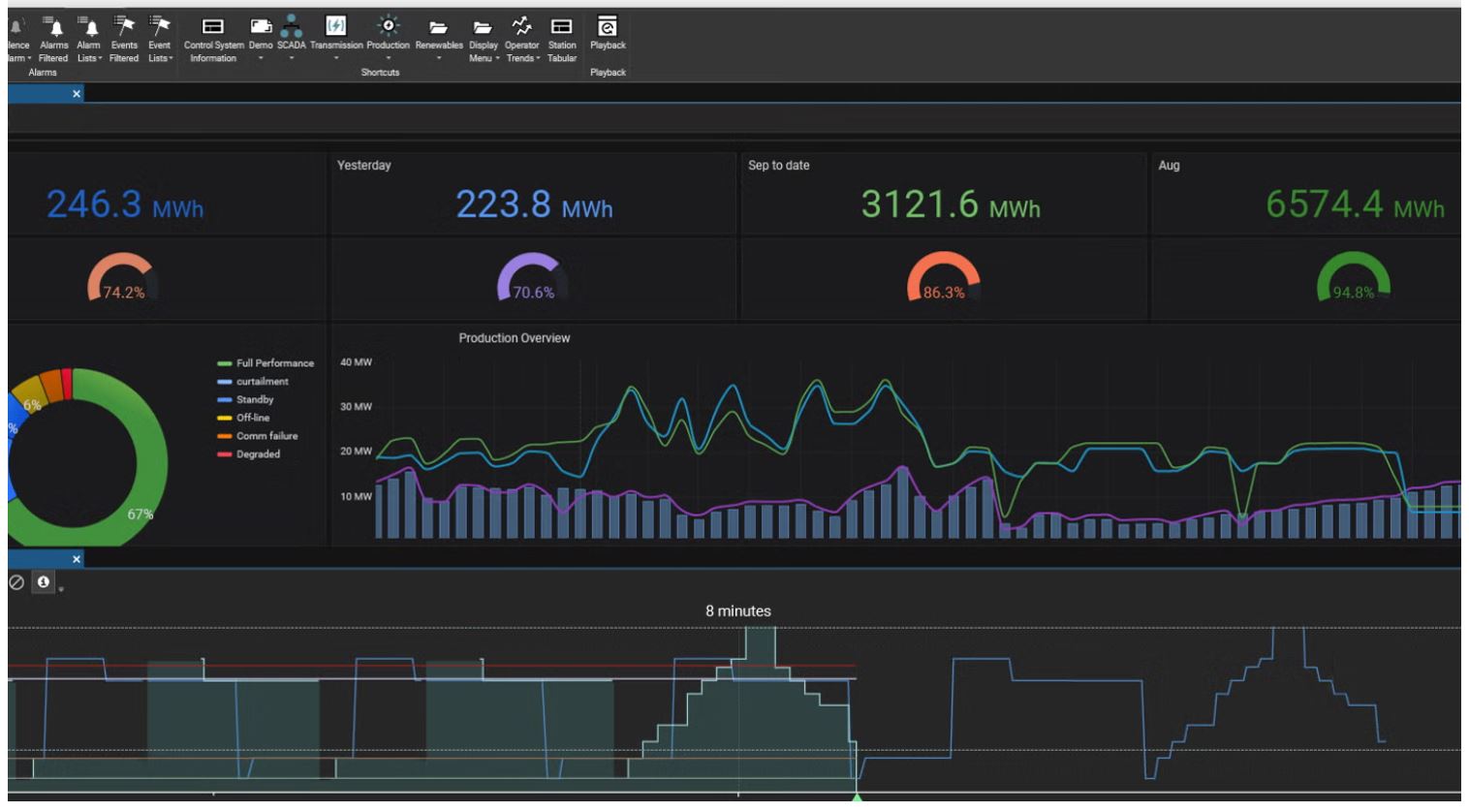
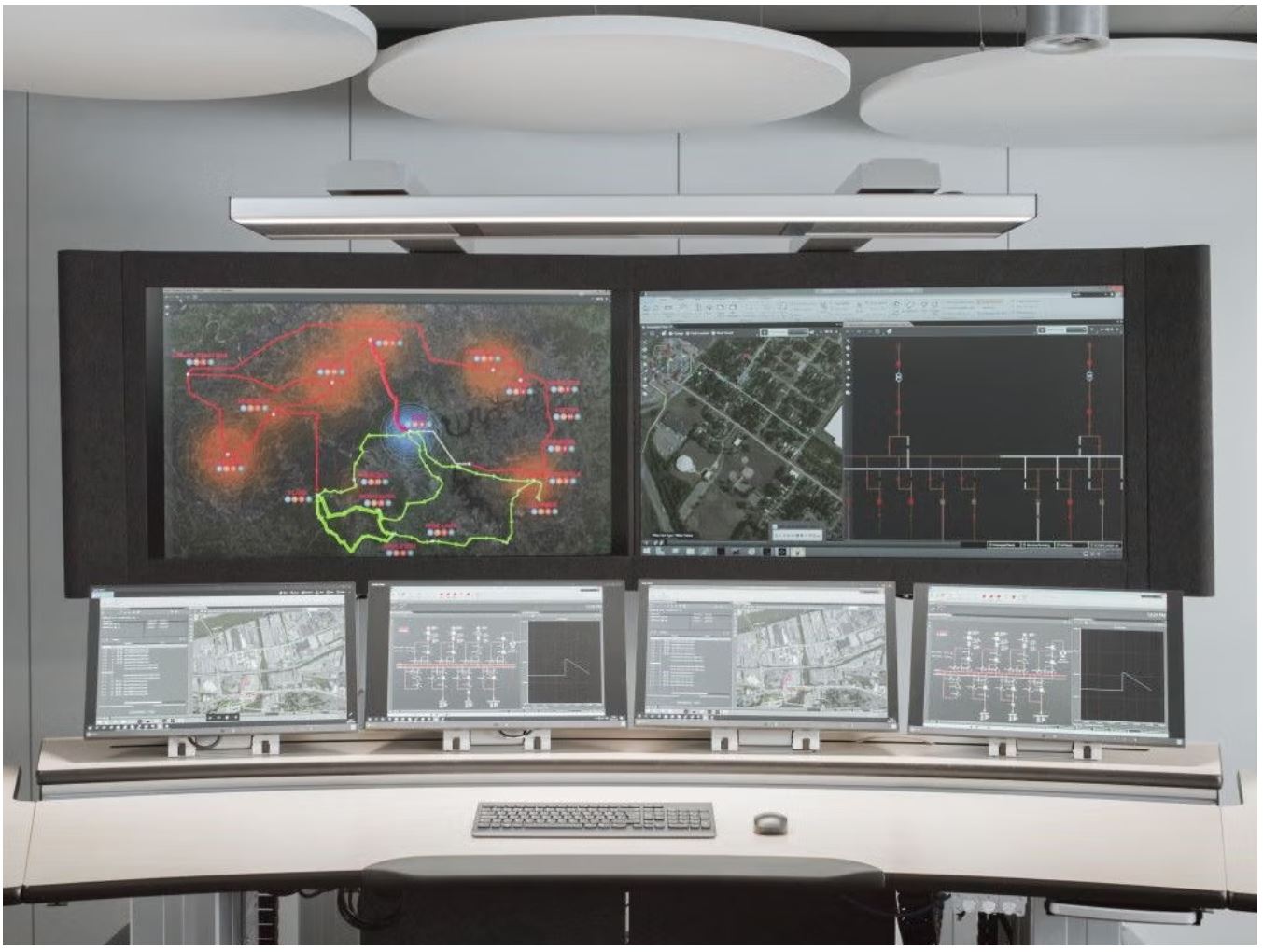
Network Manager SCADA is a platform that enables other Network Manager modules to provide value to users across a variety of industries.The modern user interface delivers enhanced situational awareness and visualizes results from advanced applications, giving operators absolute control of their infrastructure and full confidence in their operations.
Network Manager SCADA for utilities
Network Manager provides utilities with a single, unified view of the whole electrical network. For example, Network Manager’s situational awareness tools allow the user to see abnormal flow directions and overloaded corridors and visualize how the system load will change in the next 24 hours.
Benefits
- Highly scalable platform and modular design ensures that the system can grow with your future needs
- Designed for high availability, with support for multiple redundant schemes, secondary/emergency control centers, and backup facilities allowing for automatic failovers and no loss of data
- Modern HMI enhances operators’ situational awareness and provides improved decision support to shorten response time
- Easy to implement, deploy and maintain – runs in both native and virtualized environments to minimize total cost of ownership
- Open architecture allows for interoperability and integration with other IT and OT systems
Features
- Data acquisition: Collect data from remote terminal units using standard protocols, e.g., IEC, DNP, Modbus.
- Alarms and events: Check received values against limits and notify the operator. Allow the operator to acknowledge and delete alarms.
- Supervisory control: Send commands to remote devices to open or close breakers and to change analog setpoints.
- Calculations: Perform calculations on real-time values for which there is no available measurement.
- Historian: Store analog and status values with timestamps and retrieve them for playback.
- User interface: Display real-time values in schematic diagrams, list displays, trend displays, and user-defined displays
- Data engineering: Use graphical and tabular forms to create schematic diagrams, enter point configuration data, and configure alarms and calculations.
- External interfaces: Send and receive real-time data using standards-based interfaces. Exchange network models with neighboring utilities.
Network Manager Wide Area Monitoring System (WAMS)
WAMS enables you to monitor the grid in real time and detect potential issues before they escalate. It integrates with SCADA/EMS and provides visibility through a single user interface for proactive grid management. With WAMS, bring high-frequency PMU data from the field into control room operations and get actionable insights for grid stability.
Key highlights
- Act ahead of time and elevate grid stability
- Operate network closer to its physical limits
- Analyze events after they occur
Overview
WAMS is a technology that assists transmission system operators in daily operations, even prevents widespread blackouts, and assists system restoration.
The Hitachi Energy WAMS solution is designed to improve observability and situational awareness in electrical grids, today and in the future. The system collects, stores, transmits, and analyzes critical data from key points across a power network and across large geographical areas. The state-of-the-art wide area monitoring functions are designed to detect abnormal system conditions and evaluate large area disturbances. They do this to preserve system integrity and maintain suitable power system performance while offering improved scalability and higher flexibility.
Seamless integration of WAMS and EMS
Network Manager WAMS has been designed to allow seamless integration of WAMS with Network Manager EMS. This brings new, advanced indications into the operator environment and enables operators to directly use PMU measurements and high-frequency WAMS calculations in EMS applications. WAMS enhances EMS applications – like state estimation, parameter estimation, and voltage stability analysis – by providing high-fidelity, accurate measurements with high-resolution data.
Combined, these features greatly enhance operators’ awareness of the dynamic state of the power system. You gain an early warning of unsafe operating conditions and can work to avoid catastrophic power blackouts.
Act ahead of time and elevate grid stability
Detect abnormal system conditions and act ahead of time with more accurate analysis and insights into real-time grid conditions. WAMS is integrated with Network Manager SCADA/EMS. You can confidently operate with a common data engineering tool suite and a modern user interface with a single view. Our WAMS is cloud-enabled to scale and process large volumes of high-frequency PMU data.
Operate network closer to its physical limits
Integrate renewables and confidently operate your network closer to its physical limits to maximize energy delivery from existing resources, increase transmission capacity, and postpone investments in new equipment.
Analyze events after they occur
Detect and evaluate what happened, and use the insights for improved planning with playback scenarios, postmortem analysis, and the high-resolution historian database.
Features
- WAMS can be used as a standalone package or integrated with SCADA/EMS, which can operate on the same data (i.e., State Estimator for PMU)
- Common Data Engineering tool suite for WAMS and SCADA
- Modern and configurable visualization with common SCADA/EMS user interface
- High-capacity and scalable solution for large number of PMUs
- Rich suite of WAMS applications such as PAM, POM, PDM, and VSM
- Configurable user calculations
- Access to alarm, event list, and disturbance information
- Historian database for high-resolution data
- Playback scenarios
- Postmortem analysis
- Data export, offline analysis, historical trends
Applications
Advanced WAMS applications
Phase Angle Monitoring (PAM)
The Phase Angle Monitoring application facilitates the monitoring of network stresses caused by heavily loaded lines. It gives clear information of the actual corridor’s load by providing operators with real-time information about voltage phase angle deviations between two locations.
Power Oscillation Monitoring (POM)
Power Oscillation Monitoring (POM) is an application used to detect power swings in high-voltage power systems. With POM, operators are immediately aware of oscillations in power systems. The POM algorithm processes selected voltage and current phasor inputs, and it detects various power swing modes, which can lead to angular instability causing disturbances.
Power Damping Monitoring (PDM)
Damping inter-area oscillations is a major concern for many power system operators today. Consequently, the detection and characterization of such oscillations has become an important application area of WAMS. The Network Manager WAMS Power Damping Monitoring (PDM) application uses a new method for detecting and characterizing oscillations, using real-time synchronized measurements from multiple points in the power system. PDM can detect and characterize the damping behavior of oscillating modes using measurements during ambient conditions, providing operators with an effective early warning system before a disturbance in the power system triggers instability.
Dynamic monitoring and data aggregation
Phasor Measurement Unit (PMU) from Hitachi Energy
The RES670 IED (Intelligent Electronic Device) is designed for real-time and efficient wide area power system monitoring, protection, and control. It provides power system AC voltages and currents as phasors, and it is ideal to use in all types of Phasor Measurement Unit (PMU)-based applications.
Phasor Data Concentrator (PDC) from Hitachi Energy
Hitachi Energy’s Phasor Data Concentrator, PDC600, aggregates the data from the PMUs and forwards the data to the Hitachi Energy WAMS Service or to external subscribers via C37.118 or IEC870-5-104 protocol.

